Deliver value sooner
Smaller releases reach customers faster and shorten the distance between an idea and useful feedback.
A public record of what has shipped, how the product is maturing, and where the next engineering effort is going.
Since 21 July, the work has concentrated on endpoint experience, attended support, software governance, reporting, independent product identity and recovery evidence—while keeping preview packaging and general-availability claims clearly separated.
Native Windows service and Companion, managed Linux experience, deep inventory, daily update controls and attended support.
Device-authenticated commands, HTTPS, pinned SHA-256 payloads, outcome telemetry and an Authenticode gate before general Windows distribution.
Operational reporting, scheduled delivery, active-use evidence, licence governance and service workflows in one workspace boundary.
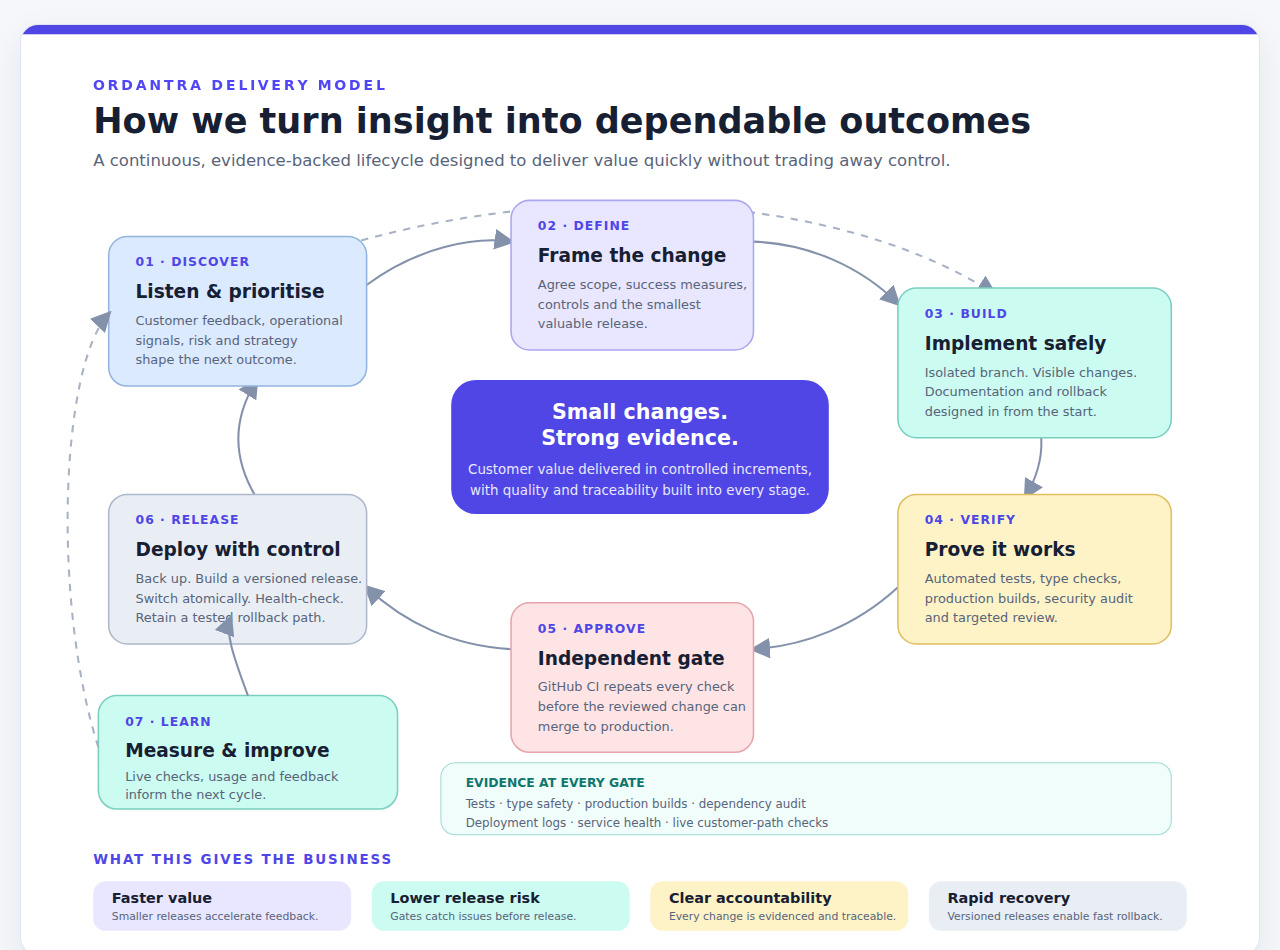
Ordantra is developed as a continuous loop, not a sequence of large, risky launches. We start with customer and operational evidence, define the smallest valuable outcome, build it in isolation, prove it independently, release it with recovery controls, then learn from the live result.
Smaller releases reach customers faster and shorten the distance between an idea and useful feedback.
Automated tests, type checks, production builds, dependency audits and targeted review catch problems before release.
Every change carries a traceable record through source control, independent CI validation, deployment and live checks.
Backups, versioned releases, atomic switching and retained rollback paths limit impact when reality differs from the plan.
Ordantra now connects an authorised support request, explicit endpoint-user consent and a time-bounded desktop session to the asset record and its audit history.
The endpoint experience moved from a passive tray icon to a current, supervised fleet touchpoint across Windows and Linux.
Endpoint evidence now feeds a governed software register rather than ending as a flat installed-application list.
Reporting expanded from summary cards into a reusable operational layer for service performance and accountable follow-through.
Ordantra completed the move from a branded application to an independently operated product boundary.
New organisations now receive a usable service foundation and a persistent, measurable path to their first managed endpoint and operational ticket.
Ordantra now has proven, server-driven update paths for both supported endpoint platforms, with release integrity and post-upgrade reporting built into the workflow.
The Windows agent now includes a persistent Ordantra tray experience and a branded, secure way to confirm or correct asset ownership details.
Workspaces are now explicit operational boundaries rather than an implicit first-record selection.
The endpoint client moved to a native Windows service and MSI foundation, then expanded into a managed endpoint product.
Ordantra added the controls teams need to shape day-to-day service delivery without editing seed data or code.
The core app was redesigned around resolver focus, richer operational context and safer change delivery.
The initial connected workflows brought tickets, endpoint risk, the ops graph and controlled change together.
These are direction statements, not claims about functionality already available. We publish them so evaluation stays grounded in the current product.